Is Vienna Tap Water Safe to Drink?
Yes. In Vienna, Austria, tap water used for drinking is potable and does not need to be purchased for consumption by visitors. It is mountain spring water through which water flow monitoring takes place from the source to the water supply.
The general rule of thumb is to avoid using all water outlets for drinking purposes. Do not use a fountain “Kein Trinkwasser”, and be careful with the water in one particular building if the quality of the water is unusual, making it look or smell unusual.
Why Is Vienna Tap Water Considered Safe?
Most of Vienna’s water comes from mountain springs in the Lower Austrian and Styrian Alps, around the Rax, Schneeberg, Schneealpe and Hochschwab. Two spring water mains, opened in 1873 and 1910, carry it to the city. According to Wiener Wasser, the city’s water utility, the journey takes roughly 24 to 36 hours, and the water flows downhill without pumps. When demand peaks, groundwater from the city’s wells tops up the supply.
Quality is checked along the way. Online monitoring equipment records water-quality readings from the protected spring areas to the city itself. Before the water enters Vienna’s pipe network, it is disinfected as a precaution with a minimal addition of chlorine dioxide or with UV light. That is then checked at the City of Vienna’s hygiene laboratories to determine whether it fulfils the legal requirements.
This is in line with what the Austrian National Tourist Office states throughout the country: The use of tap water from the public supply is permitted, and the Austrian Drinking Water Ordinance specifies standards.
Can Tourists Drink Tap Water in Vienna Hotels and Restaurants?
Hotels & Holiday Apartments
Taps in hotels and apartments connected to the city network deliver that same water. The one variable is the building. The city supply and a building’s own pipework are separate things, and Wiener Wasser publishes advice on spotting lead pipes in older buildings and having water tested. If you are in an older property and think you are unsure, then ask your host.
Restaurants & cafés
Order Leitungswasser (Germany’s term for tap water); what you get is drinkable water. It has been the custom of Viennese cafes to provide a glass of water served with coffee, which the Vienna Tourist Board rates as “a seal of quality. Otherwise, don’t expect it to be free.
In Austria, venues can charge users for the water used for drinking, but only if it is included in the menu. The Chamber of Labour (AK Wien) identified 23 restaurants and cafés charging for it in 30 restaurants and cafés in Vienna in a spot check in the summer of 2026, even if the guests had ordered food or drinks. This was provided at no cost by three. A half-litre cost between €0.80 and €3.60.
The lesson to learn is that it’s a small sample, but you won’t get a shock at the bottom of the bill. Who remembers Vienna coffee houses? We have written a guide to Vienna’s historic coffee houses, so you will find out where the tradition is still alive.
Where Can You Refill Your Water Bottle in Vienna?
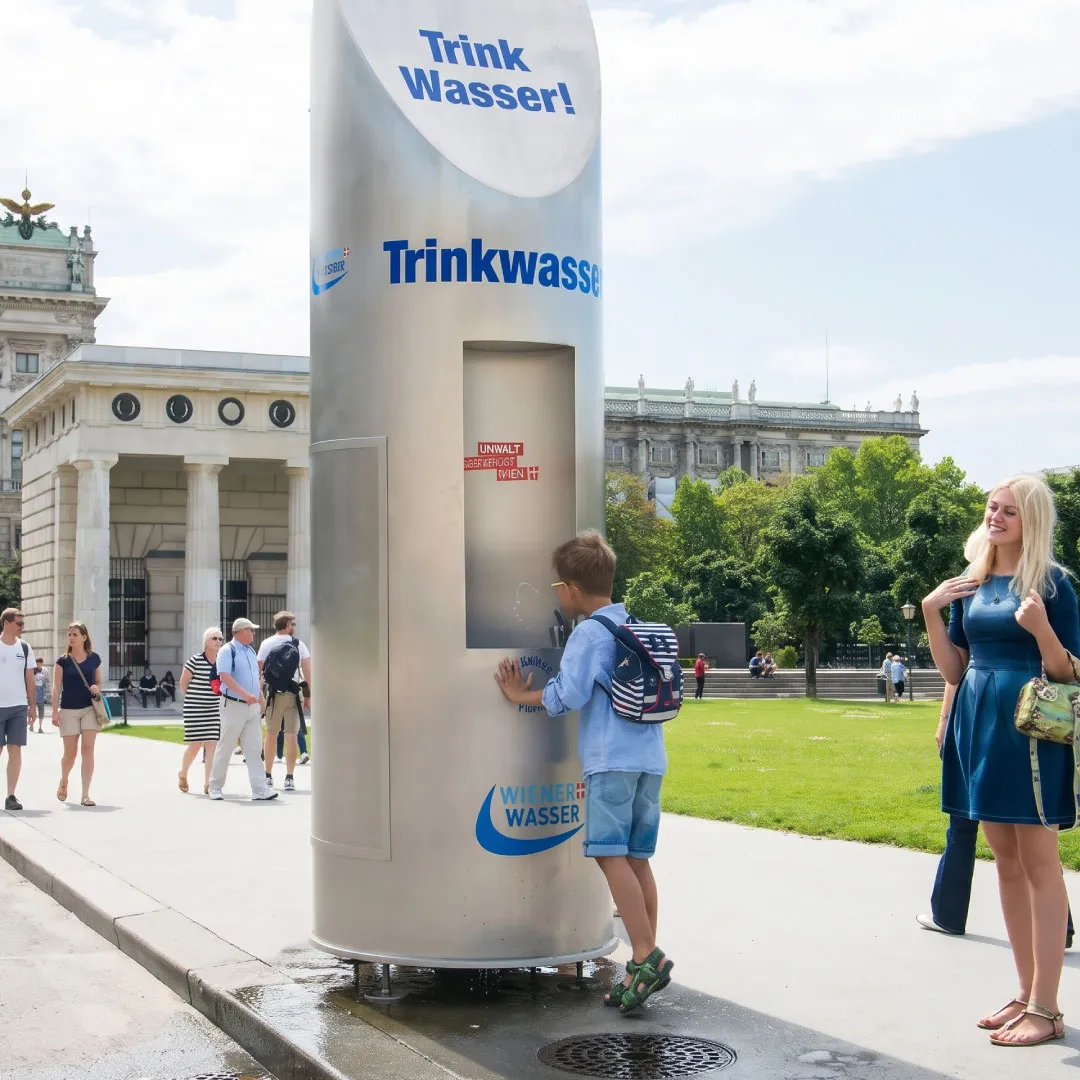
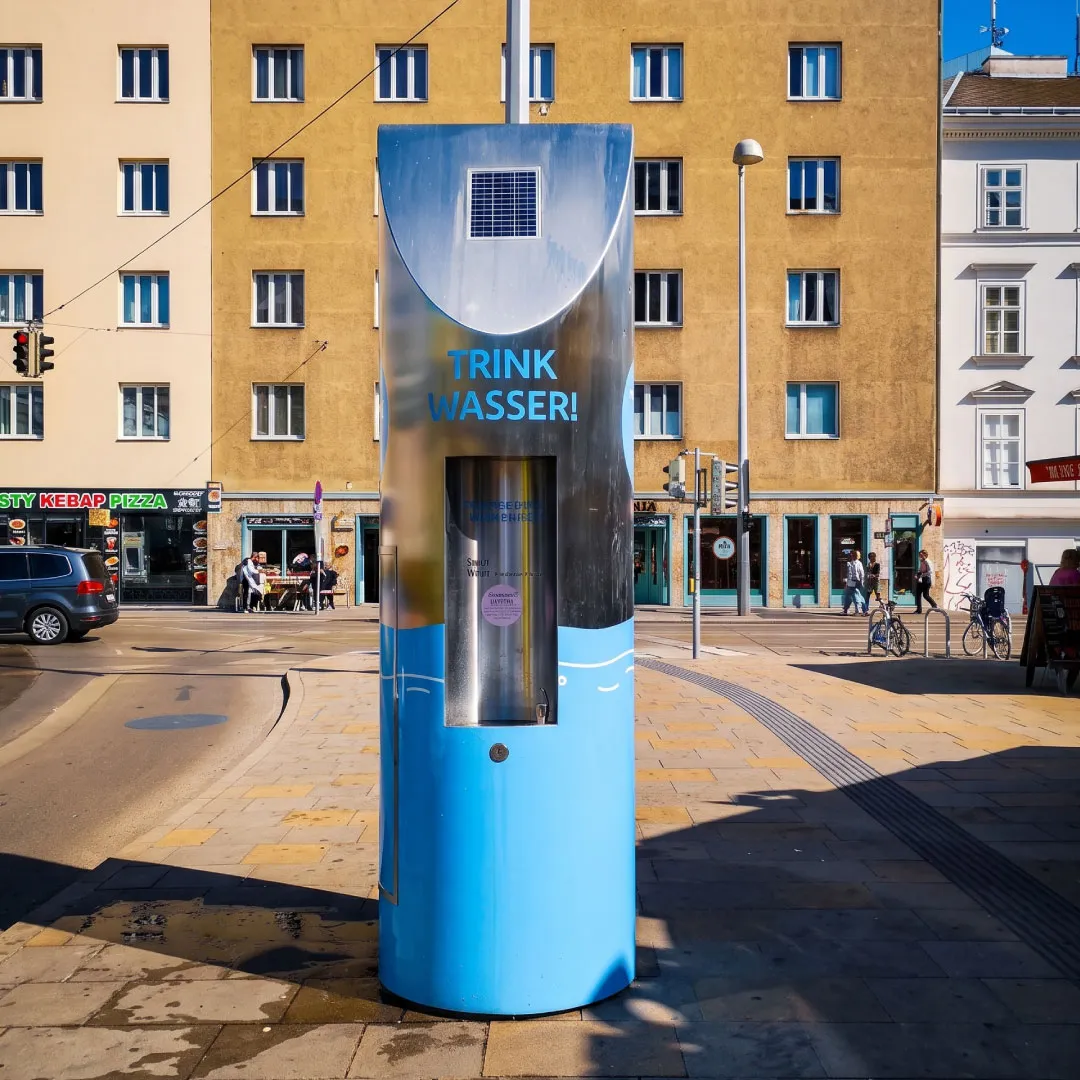
No problem, during the warm season. The City of Vienna has 1,800 public drinking fountains in parks, in busy places, or at markets. They are extremely noticeable (the tallest, of course, are called Brunnhilde) and also release a cooling mist when it is really hot.
How to tell a drinking fountain from a decorative one?
In addition, Vienna has approximately 55 grand monumental and historic fountains – such as Maria-Theresien-Platz and Schwarzenbergplatz. The Austrian National Tourist Office says that their water isn’t potable. “Kein Trinkwasser” is right: it means no drinking water! If in any doubt, don’t drink it.
You’ll be able to view drinking fountains on the City’s online map (the Stadtplan), so please use it before heading out on a long walk.
Fountains Close for Winter
This matters if you are visiting now. Wiener Wasser began draining the city’s drinking and monumental fountains in late October 2026 to protect them from frost, starting at the edges of the city and finishing in the centre. They are due back in spring 2027. Prior to that, obtain a bottle at the room where you’re staying. Existing taps remain unaffected (indoor taps most likely).
Do You Need to Buy Bottled Water in Vienna?
The answer for most people is NO; bottled water is a choice, not a need. In Austria, natural mineral water is treated separately, and if you prefer a taste or prefer sparkling drinks, then it is a perfectly good alternative.
Taste may differ from home. Wiener Wasser reports that the hardness of the water in Vienna is about 6° to 12° of the German hardness, and is greater in certain districts. That’s a description that applies to minerals, not hygiene, and one that can make you see limescale on kettles. Tap water doesn’t require any packaging, and that fits a reusable bottle.
When Should You Avoid Drinking Tap Water?
There are a few times, though, to take caution: very rarely.
- A warning or notice: Do not drink the water if the authorities advise against it or if the accommodation has informed you not to drink the water. An exception to that would be if there is a local warning and a general statement for the city; the exception takes precedence.
- Cloudy or unusual water: All Wiener Wasser milky-white water with no need for clarifying is air bubbles. If there are other particles that are settling at the bottom, or if the water appears odd in color or taste, or smells funny, don’t take the risk: don’t drink it, and let your host know about it. Contact the duty team of Wiener Wasser 24 hours a day at +43 1 599 59.
- Fountains and outdoor outlets: Do not drink water from the “Kein Trinkwasser” signs, monumental fountains, or from an unmarked outdoor tap.
- Doubtful plumbing: If the problem is in one building, it’s a building problem and not a City problem. Only use bottled water until your host has said it’s fine.
Wrapping Up
The water in Vienna’s water pipes is potable, and all you need is a reusable plastic bottle. Fill up at your accommodation, use clearly marked drinking fountains in the warmer months, and treat every “Kein Trinkwasser” sign as a firm no.
In the middle of the day, in front of the Burgtheater, our private Vienna sightseeing tours depart, and coffeehouses abound if you need to take a break during your slower day in the centre.
Frequently Asked Questions (FAQs)
Q: Can you drink tap water in Vienna without boiling it?
A: Yes. Water from the public supply is drinking water and needs no boiling. The exception is an official or local notice telling you otherwise.
Q: Is Vienna tap water better than bottled water?
A: Neither is necessarily better: both are regulated. This is an inexpensive and waste-free method (all the water is tap water), and bottled mineral water will appeal to those who like its fizz or taste.
Q: Can you drink from public fountains in Vienna?
A: Yes, from marked drinking fountains (*Trinkbrunnen*) while they are in season. Never from monumental or decorative fountains, or anything labelled “Kein Trinkwasser”.
Q: Do restaurants in Vienna serve tap water for free?
A: Not always. In the past, coffeehouses would provide a glass of coffee for members to drink, but now if the price is listed on the menu, then the venue may charge the member to drink. Submit a request for Leitungswasser, and review the Drinks List.
Q: Can tourists refill reusable water bottles in Vienna?
A: Yes, at the pets’ drinking water (hotel or apartment tap) and at drinking fountains. Fountains are seasonal, with the 2026 winter break underway and a return planned for spring 2027, so check the City’s map.