Archduke Karl Monument Vienna: History of the Hero of Aspern
By Libra Tours
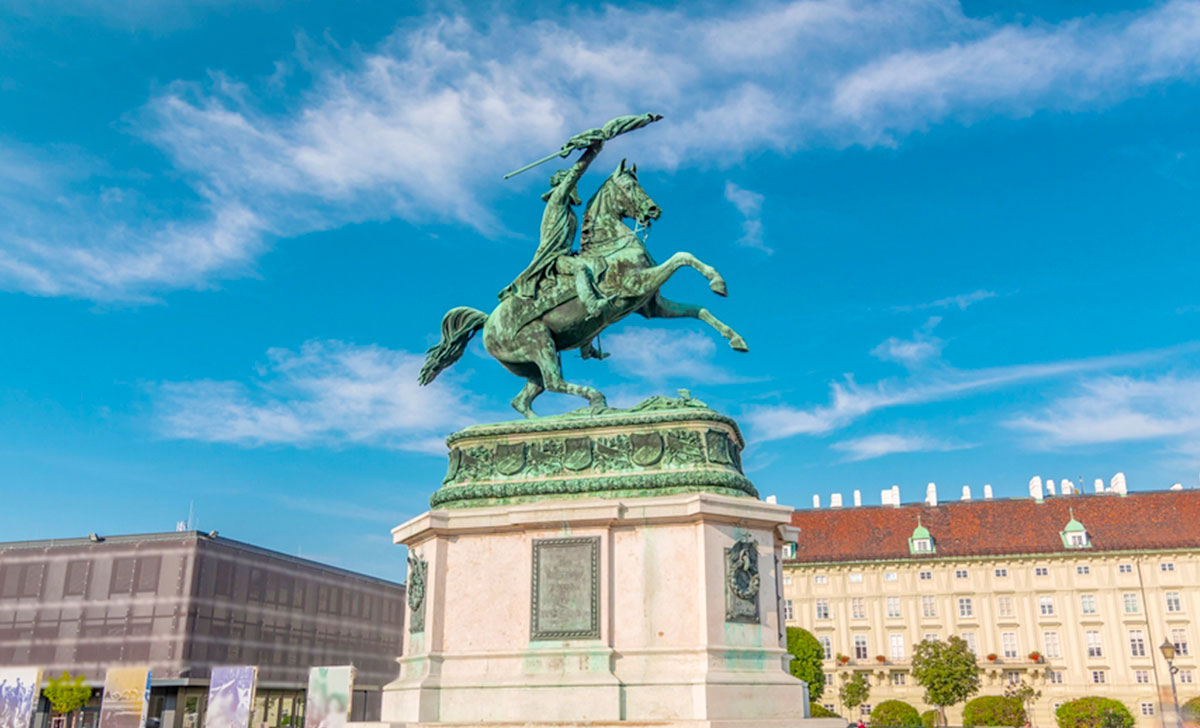
Archduke Karl monument Vienna is not just a statue; when you stand on the northern side of Heldenplatz, you will notice that the bronze horse is actually moving with centuries of history & timeless aesthetics.
Its front legs are folded in the middle of the stride, its hindquarters coiled, flag up, cloak tossed back, rider leaning into an unlanded charge. Walk by this monument, and you will relive the history of 250+ years.
It’s a portrait of the one general who ever handed Napoleon Bonaparte a battlefield defeat, cast in a pose so structurally audacious that it had never been attempted at this scale before.
Give it ten minutes, and it becomes one of the most rewarding stops in Imperial Vienna.
Quick Facts At a Glance
| Detail | Information |
| Location | Heldenplatz Vienna, 1010, facing the Neue Burg |
| Unveiled | 22 May 1860 (commissioned 1853) |
| Sculptor | Anton Dominik Fernkorn; pedestal by Eduard van der Nüll |
| Material | Cast bronze on a stone pedestal |
| Scale | Est. 10.5-tonne bronze, monumental scale |
| Entry Fee | Free, open public square |
| Best Time | Early morning, spring, early autumn |
| Time Needed | 10-15 minutes |
| Nearest Metro | Herrengasse (U3) or Volkstheater (U2/U3), ~5 min walk |
| Photography | Excellent, dramatic silhouette, golden hour |
Who Was Archduke Karl?
Erzherzog Karl (1771-1847), Duke of Teschen, was the 3rd son of Emperor Leopold II, born in Florence, and was the younger brother of Emperor Francis II.
Reared in Vienna, he entered the Austrian army in 1792, and despite having epilepsy, he was one of the strongest field commanders of his day.
In his early battles, he had success at Neerwinden and went to break the French armies at Amberg, Würzburg and Zürich. From 1801, he was president of the Hofkriegsrat, and he was responsible for reestablishing the Austrian army from scratch, with the measure of conscription-based reforms long before they were most needed, and French-style techniques.
The Battle of Aspern-Essling
Ominously, by 1809, Napoleon had been victorious in all. On 21-22 May, the army, some 100,000 strong, attempted to cross the Danube near Vienna on hastily built pontoon bridges but was checked by Archduke Karl’s army, some 100,000, at the villages of Aspern and Essling.
After fighting in the streets for two days, finally Karl’s cavalry reserve broke the French center, and Napoleon fled back to Lobau Island, leaving behind the bodies of over 20,000 soldiers, including the ailing Marshal Jean Lannes.
Although six weeks later, Napoleon reverted to the offensive at Wagram, it was his first serious defeat in ten years and Austria’s morale-boosting reply to their Austerlitz.
It was Napoleon’s first serious field defeat in ten years, Austria’s morale-defining answer to Austerlitz, even though Napoleon reversed the setback six weeks later at Wagram.
History of the Monument
It was in 1853 that Emperor Franz Joseph I ordered the creation of the Erzherzog Karl Denkmal, on his own, and tasked Anton Dominik Fernkorn with creating a model for the monument as early as 1847.
After Karl admired the battle painting by Johann Peter Krafft (1768–1854), creating it required two and a half years because Fernkorn worried about how to create a sculpture without a tail to support the horse and no additional strut to support the rider. After studying Krafft’s 1809 painting, Karl spent years figuring out how to make the sculpture without a tail to support the horse nor any extra strut for the rider, a feat never performed of this scale prior to the casting.
Also designed around the anniversary of the battle, the bronze was cast in eight parts in 1858-59, and inaugurated on 22 May 1860. But on his subsequent sculpting projects, he was unable to duplicate the feat, and he used the base instead for that of Prince Eugene’s companion horse.
Symbolism & Architectural Details
Karl’s horse rears directly over a fallen French standard and eagle, an unambiguous symbol of Aspern’s outcome. He raised his flag to represent when the line had become frayed, and he personally rallied it.
The coat of arms of the Archduke is depicted on a stone pedestal designed by Eduard van der Nüll, together with two battle names in bronze shields, placed at each chamfered corner of the pedestal, and two double-headed eagles, on two other chamfered corners, each with Franz Joseph’s monogram.
The visitors hardly pay attention to the fact that the pedestal inscriptions had been reviewed by the poet in advance, without which they would not have been published.
Why You Must Visit
Apart from its history, it’s one of the most photogenic monuments in Vienna: without restrictions, rearing forward and inviting onlookers, open to the public and available at all hours, a ready-made five-minute detour just for those heading towards the Hofburg or the museums around the Ring.
Nearby Vienna Sightseeing Attractions
- Prince Eugene Statue: Fernkorn’s companion equestrian monument, directly across the square
- Neue Burg: Curved Hofburg wing behind the monument, home to the Weltmuseum
- Sisi Museum & Imperial Apartments: A short walk east through the Hofburg complex
- Spanish Riding School: Just north of Heldenplatz Vienna
- Austrian National Library: Adjoining the Hofburg, a few minutes north
- Burgtor & Volksgarten: Through the outer gate, a WWI memorial since 1933-34
- Burggarten & Albertina: A few minutes southeast for a longer Imperial Vienna loop
Suggested Vienna Walking Tour Itinerary Around the Monument
2 Hour
- Archduke Karl Monument
- Prince Eugene statue
- Neue Burg exterior
- Burgtor
4 Hours
- Everything in the 2-hour route
- Sisi Museum & Imperial Apartments
- Michaelerplatz
Half-Day
- Everything in the 4-hour route
- Spanish Riding School exterior
- Austrian National Library
- Burggarten
- Albertina Museum
Archduke Karl Monument Interesting Facts
- This was the first noble ground defeat faced by Napoleon at Apern-Essling in 10 years.
- Karl had approximately 100,000 men there; Napoleon had 60,000.
- The Archduke Karl statue rests on only two points of contact, a first for a monument at this scale.
- It weighs an estimated 10.5 tonnes of cast bronze.
- The emperor ennobled Fernkorn for solving the balance problem.
- He couldn’t repeat the trick for the Prince Eugene statue five years later; that horse needed its tail as a third support.
- The pedestal inscriptions needed the poet Grillparzer’s approval before casting.
- Franz Joseph I paid for the monument out of his own funds.
- The unveiling was delayed a year by Austria’s 1859 defeats in Italy.
- The square wasn’t officially named Heldenplatz until 1878.
Travel Tips
- During spring and early summer, light and quiet times are best, and before 9 am.
- There are no steps in the square, and it is fully wheelchair accessible.
- Cafés line the nearby Ring and Michaelerplatz for a coffee stop before or after.
- The closest public toilets are in the Hofburg museums.
- Plan for comfortable shoes as this is a jumping-off point for a longer walking loop, not one stop.
Plan Your Visit
So, the next time you’re tracing the Ring past the Hofburg, give the man on the rearing horse his ten minutes. If you’d rather have a local guide narrate this stretch of Imperial Vienna in person, that’s exactly the kind of story Libra Tours’ private, electric-vintage carriages are built to tell on the way past.
Our best tours in Vienna take off from the Burgtheater (next to the Glockenspitze on Heldenplatz, which is just a short 10 min walk away from the tourist office) in a vintage-style electric carriage and are operated by private tour guides; packaged trips are available for Vienna, Burgtheater.
Frequently Asked Questions (FAQs)
Q: Who defeated Napoleon for the first time?
A: With his first major defeat in a decade at the Battle of Aspern-Essling on 21-22 May 1809, Napoleon suffered his first defeat as an emperor.
Q: Why is Archduke Karl important?
A: He modernised the Austrian military and was the sole commander to stand up to Napoleon on his back in a turning-point confrontation, making a living legend in Austrian military resistance in the Napoleonic Wars.
Q: Where is the Archduke Karl Monument?
A: On the northern half of Heldenplatz (Vienna 1st district) opposite the Neue Burg wing of the Hofburg Palace.
Q: What happened at the Battle of Aspern-Essling?
A: Napoleon’s forces attempted to ford the Danube on pontoon bridges, while Karl’s and his troops were able to occupy the villages of Aspern and Essling, forcing a costly retreat through the enemy camp after two days of battle.
Q: Can I visit Hofburg and Heldenplatz together?
A: Yes, Heldenplatz forms Hofburg’s outer courtyard, so the monument, Neue Burg, and Hofburg’s museums naturally combine into one walk.
Q: What monuments are located in Heldenplatz?
A: At the square can be found statues of two members of the imperial family, Archduke Karl and Prince Eugene of Savoy.