Michaelerplatz | 2026 Guide to Vienna’s Most Historic Square
By Libra Tours
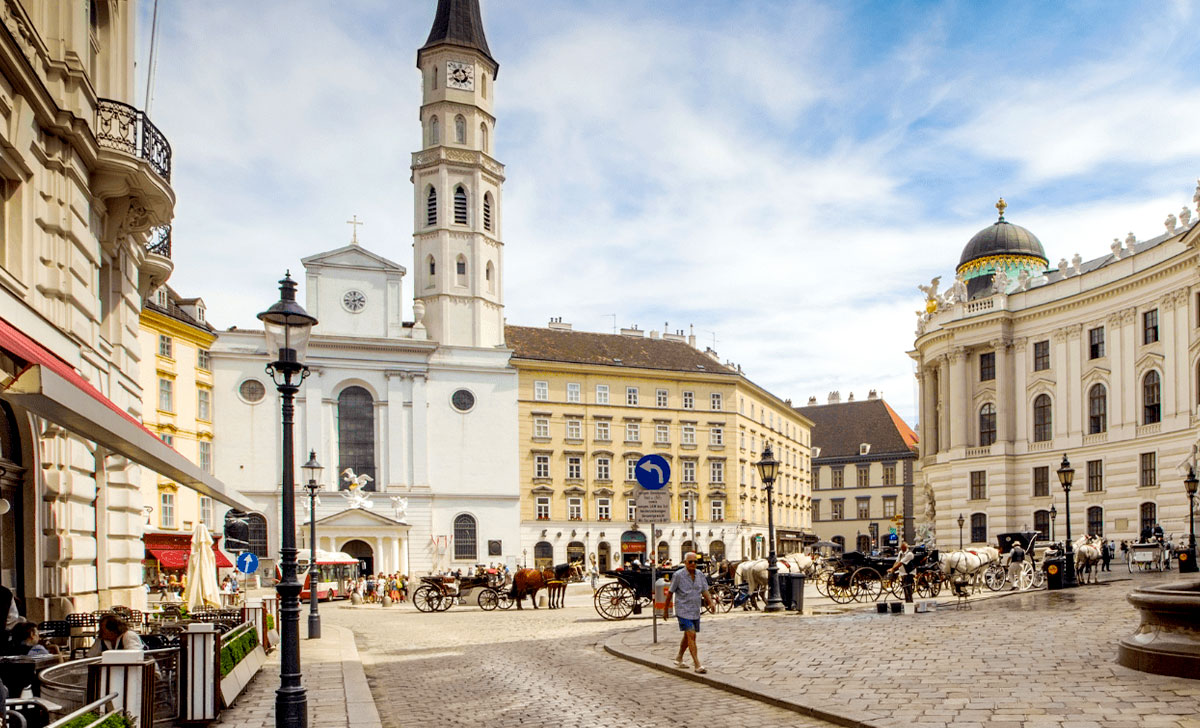
Michaelerplatz is that square in Vienna, where you will circle a thirteenth-century church, a curved Baroque façade of an imperial palace, one of the most controversial buildings in modern Europe, and, at your feet, the remains of the Roman Vienna that was dug up.
This is exactly how “dense” this little square is, and that is why your thirty seconds is not enough here.
What Is Michaelerplatz?
The Michaelerplatz is a star-shaped and Baroque square in the Inner City (1st district) of Vienna and serves as the entrance from the northeast to the Hofburg Palace. With visible Roman and medieval excavations, the domed Michaelertrakt palace wing, and the landmark modernist Looshaus, all of these are grouped into a single open plaza, named after the adjacent St. Michael’s Church.
The Square has served as a crossroads for most of its history as several of its historic streets riddle it: Kohlmarkt, Herrengasse, Schauflergasse, and Reitschulgasse. It was even the location of Vienna’s first car roundabout in 1927.
Why Is Michaelerplatz Historically Important?
Michaelerplatz matters because Vienna’s entire timeline is stacked here in visible layers.
Roman Vienna
At the time of the Romans (1st century AD), the location was just beyond the walls of the Roman legionary camp Vindobona, which was situated in the civilian settlement where three main roads converged.
Medieval Vienna
During the Middle Ages, the area formed part of the Witmarkt (wood market) of the city. The square was named after St. Michael’s Church, which was built here in the early 13th century.
Habsburg and Baroque Vienna
For good measure, the crossroads replaced the front door to the palace as the Hofburg started to grow. The Michaelertrakt wing, which decisively sweeps away toward the corner by Joseph Emanuel Fischer von Erlach from the 1720s, was stalled for some 160 years before the former Burgtheater was demolished in 1888. This led to the creation of an early 18th-century design’s Baroque façade, which is in fact a late 19th-century construction.
Viennese Modernism
Across the street from the palace, Adolf Loos constructed his no-nonsense Looshaus in 1910, an offense that was a great scandal in imperial Vienna and today a milestone of modern architecture.
Modern Vienna
The city recently completed a refurbishment of the square’s public space, including the addition of trees, a project that stirred its own debate, proving Michaelerplatz still provokes strong opinions about how Vienna should look.
Michaelerplatz and the Roman Ruins
In 1990-91, during works to renovate the house, some genuine Roman roads and house foundations were found, as well as later medieval remains. Instead, the city decided not to bury them, but it left the excavation exposed in the center of the square, free and open forever.
Today, what you see are low walls and street fragments, not majestic ruins, but what is remarkable is the context. While you appreciate a Roman guardhouse and the surrounding civilian neighborhoods, the house of the Habsburg emperors stands directly behind you. Interpretation panels come in handy; go into the Metropolitans of the Norwalk Assembly, not Pompeii.
The Hofburg and Michaelerplatz
The Michaelertrakt (curved Neo-Baroque wing of the Hofburg) with its copper dome and monumental Michaelertor gate dominates the gracious little courtyard in the southwest. Walking through it leads to the imperial complex, which houses the Sisi Museum, the Imperial Apartments and the Spanish Riding School.
The decoration on the dome’s surface, the muscular Hercules statues flanking the gate and the wall fountains on either side of the curve of the facade are all visible from the square. The entire ensemble was intended to delight strikers from the city arriving at the palace, and it still does when lit at night.
St. Michael’s Church
St. Michael’s Church (Michaelerkirche) on the other side is one of the oldest churches in Vienna, dating back to the early 13th century. The building’s architecture is also a history lesson: its core is of late-Romanesque origin, but is behind a Neoclassical facade, and is enriched by Gothic and Baroque features on the inside.
The church is closely connected with Mozart: part of his unfinished Requiem was performed here for the first time, in December 1791, at Mozart’s memorial service. On certain days there are guided tours to the crypt where remarkably preserved burials can be seen, so please refer to the parish’s timetable for times before visiting, which are subject to change throughout the year.
Looshaus: Vienna’s Modernist Counterpoint
The Looshaus (designed by Adolf Loos and completed in 1910) is opposite the palace. The city was a city of ornament, and its uppermost tier was devoid of exterior decoration, while its clean marble lower stories were an affront. Critics mocked it as “the house without eyebrows.”
It is said that the Emperor Franz Joseph did not like the building, and as a consequence never used the Michaelertor thereafter. This is pure folklore, but there is a definite tension between the two buildings, and standing between them will convey it.
The confrontation of imperial baroque with early modernism is closest just here in Vienna. It now provides the services of a bank; access to the ground floor should be possible during business hours.
What to See at Michaelerplatz?
- Michaelertrakt and dome: Study the sculptural groups and fountains along the curve
- Michaelertor: The ceremonial gate into the Hofburg
- Roman and medieval excavations: The sunken display at the square’s center
- St. Michael’s Church: Note the Romanesque stonework behind the Neoclassical front
- Looshaus: Compare its bare upper floors with the palace opposite
- Kohlmarkt view: The luxury shopping street framing the Graben beyond
- Fiaker carriages: The horse-drawn cabs line up here like cabs, producing the period atmosphere.
Best Things to Do Around Michaelerplatz
Things within one mile of the step-and-a-half home walk:
- Sisi’s museum, Sisi’s apartments
- The Spanish Riding School (morning exercise sessions are a favorite)
- Heldenplatz
- The Austrian National Library’s State Hall
- The Burggarten
- Café Demel on Kohlmarkt
- St. Stephen’s Cathedral via the Graben.
If you’d rather have the layers of the square decoded for you, Roman, Habsburg, and modernist in one narrative, a private tour guide in Vienna offered by Libra Tours, lets you cover Michaelerplatz and the Hofburg quarter at your own pace.
How Long Do You Need at Michaelerplatz?
- 15-20 minutes: Photos, the excavations, and a look at all four architectural faces
- 30-45 minutes: Add the interior of St. Michael’s Church and a proper study of the Looshaus
- 1-2+ hours: Combine with the Sisi Museum, Imperial Apartments, or Spanish Riding School inside the Hofburg
Best Time to Visit Michaelerplatz
Michaelertrakt is lit by soft light in the early morning hours (before 9:00), and the square itself is emptiest at this time. The crowd, carriages, and street life are more apt for the atmosphere than photography in the middle of the day.
Twilight and evening are ideal; the lit-up façade of the Hofburg is one of the views that is signature to the square. There is normally a little Christmas market in Advent, usually most crowded in the summertime afternoons.
Photography Guide
- The Classic Shot: Stand near the Looshaus and frame the full curve of the Michaelertrakt with its dome
- The Contrast Shot: Capture Looshaus and Hofburg in one frame, the whole modernism debate in a single image
- Blue Hour: The illuminated dome over a dark blue sky is the square’s top light.
- Detail Work: The sculptures of Hercules, the fountain sculptures, the Romanesque stonework of the church
- Street Life: Fiaker carriages passing the palace gate make natural period compositions
A wide-angle lens helps; the square is compact and the buildings tall.
How to Get to Michaelerplatz?
On foot
About 7-8 minutes from Stephansplatz via the Graben and Kohlmarkt, arguably Vienna’s most elegant approach; roughly 10-12 minutes from the State Opera
U-Bahn
The nearest station is Herrengasse (U3), which is about a 2-minute walk; Stephansplatz (U1/U3) is nearby.
With Libra Tours
Experience a slow electro vintage ride across Vienna’s imperial center with a private local guide.
Address: Michaelerplatz, 1010 Vienna
Is Michaelerplatz Free to Visit?
Yes. This is an open access site allowing free public entry and access at all times to the square, the open-air Roman excavations, and to the building exteriors.
Some of the attractions around town, admission to the Sisi Museum, the Imperial Apartments, performances at the Spanish Riding School, and guided tours of the crypts at St. Michael’s are all included in the admission. Opening times and prices are subject to change; visit official websites to check before visiting.
Accessibility
Generally, an even, pedestrian-level square with settlement surfaces suitable for wheelchairs, though it is not all smooth and easy to maneuver on; possibly cobbled and carriage traffic needs watching. Examinations of these excavations can be done in the upper viewpoint, which means that there are no steps to climb to view the excavations.
Museums at Hofburg have easily accessible entries; please consult the official page on accessibility. Historic church interiors may not be accessible.
Visitor Tips & Etiquette
- Prayer services when entering St Michael’s Church: Respect services, keep voices low
- Please don’t obstruct the Michaelertor – it’s not a thoroughfare, but a path for walking and riding.
- Watch for Fiaker traffic crossing the square
- Wear comfortable shoes; the streets around the area are cobbled.
- In the holiday season, book tickets for the Spanish Riding School and Sisi Museum in advance.
Suggested Walking Route (60-90 minutes)
Michaelerplatz → St. Michael’s Church → Roman excavations → Michaelertor/Hofburg → Heldenplatz → Spanish Riding School exterior → Josefsplatz → Kohlmarkt → Graben → Stephansplatz. This route reads Vienna’s history in rough chronological order — Roman, medieval, imperial, modern, and ends at the cathedral.
Suggested Half-Day Itinerary
9:00: Coffee near Kohlmarkt (Demel is steps away)
9:45: Michaelerplatz for excavations, church, Looshaus
10:30: Sisi Museum and Imperial Apartments
12:00: Heldenplatz and the National Library’s State Hall
13:15: Walk Kohlmarkt and the Graben to St. Stephen’s Cathedral
At Libra Tours, we design custom Vienna sightseeing tours that can easily fit into your itinerary without making drastic changes.
Interesting Facts About Michaelerplatz
- It is built on the top of the civilian neighborhood of the Roman camp Vindobona, where three Roman roads converge.
- The Michaelertrakt was planned in the 1720s but wasn’t finished until the late 19th century.
- The first car roundabout in Vienna was here in 1927.
- The medieval square was a wood market (Witmarkt).
- The archaeological remains of the Romans were only excavated in 1990-91.
- The Looshaus was also known as the “house without eyebrows.
- Mozart’s memorial service was held at St. Michael’s Church in 1791.
- Until 1888, the old Burgtheater was located on the square.
- The now historic café, Café Griensteidl, was located in Palais Herberstein on the square.
- The square was recently updated but received new frescoes to debate over it, and trees.
Michaelerplatz vs Other Historic Squares in Vienna
Stephansplatz has the cathedral, Heldenplatz has scale, Josefsplatz has Baroque perfection, and Am Hof has medieval roots. But only Michaelerplatz shows you Roman, medieval, Baroque, and modernist Vienna simultaneously.
It’s the best place in Vienna to see how the city grew up layer upon layer, and, in case of absence, it requires no effort to skip it as it is directly on the way to walk from Stephansplatz to the Hofburg.
Is Michaelerplatz Worth Visiting?
Yes, particularly for those who like History, architecture, and photography. It is free, requires only 15 minutes, and offers perhaps the widest historical range for a building in Vienna per square meter.
Don’t be optimistic though, it’s just a small square and isn’t much of a purpose in itself, more like the first stop in a much longer Inner City stroll.
Frequently Asked Questions (FAQs)
Q: What is Michaelerplatz famous for?
A: Not only: history is layered here on one square: Roman excavations can be seen, then the baroque entrance to the Hofburg, the St. Michael’s Church (13th century), as well as the modernist Looshaus.
Q: Where is Michaelerplatz in Vienna?
A: In the 1st district (Innere Stadt), northeast at the door to the Hofburg at the intersection of the streets of Kohlmarkt, Herrengasse, Schauflergasse and Reitschulgasse.
Q: Are the Roman ruins at Michaelerplatz real?
A: Yes. They are authentic Roman road and building evidence from the civilian suburb of Vindobona, which was discovered in the course of the renovations in 1990-91 and is permanently exhibited.
Q: Can Michaelerplatz be included in a private Vienna tour?
A: Yes, it features in most Inner City walking routes, and private operators like Libra Tours include it in customized Hofburg and Vienna old town itineraries.