Votive Church Vienna: Complete Visitor’s Guide
By Libra Tours
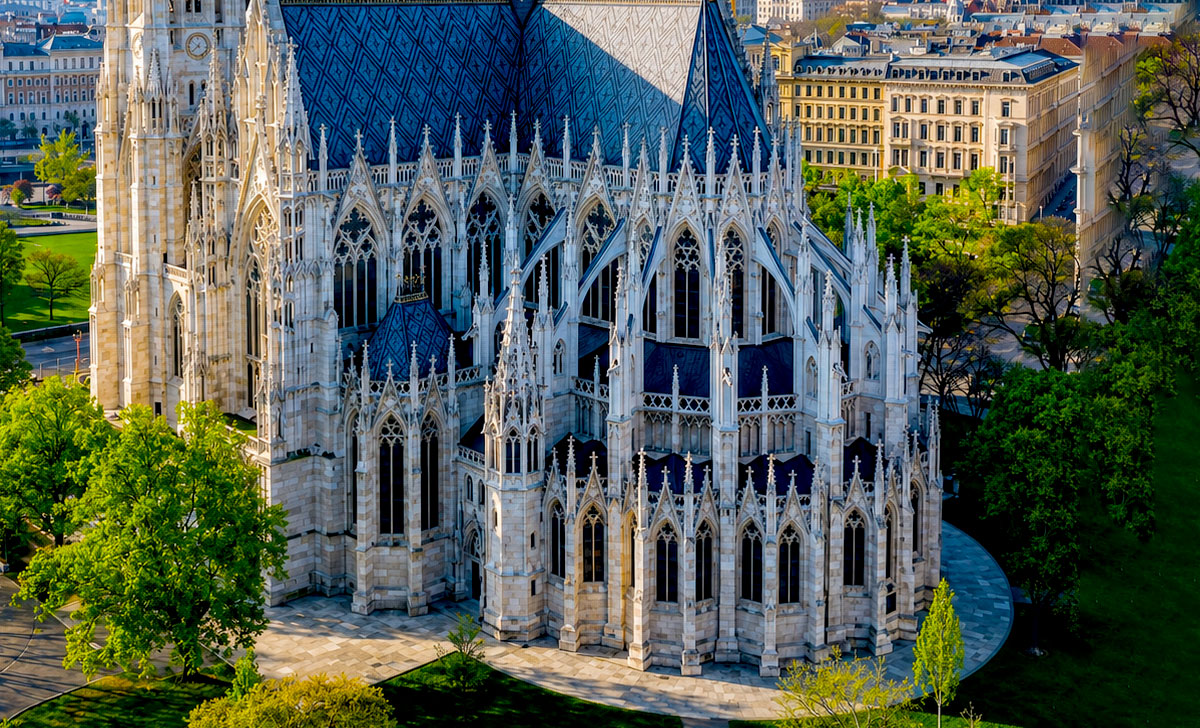
If you are looking to visit Votive Church Vienna, Austria, you’ve landed at the right place.
The Votivkirche built in 23 years (1856-1879) is the 2nd tallest church (99 Meters) after St. Stephen’s Cathedral & one of the finest neo-Gothic buildings in Europe. It stands tall over Vienna’s Ringstraße, like someone carved an ice mountain.
Scroll down slowly & learn everything about The Votivkirche before exploring this wonder in Vienna.
Quick Facts at a Glance
| Details | Information |
| Address | Rooseveltplatz 8, 1090 Vienna (Alsergrund) |
| Built | 1856–1879 (23-year construction) |
| Architect | Heinrich von Ferstel |
| Style | Neo-Gothic, French-cathedral inspired |
| Height | 99 m twin towers, 2nd-tallest church in Vienna |
| Entry fee | Nave free; museum & light show ticketed separately, verify current pricing |
| Best time | Weekday mornings, best stained-glass light, fewer visitors |
| Time needed | 30-45 min (church only); 60-75 min with museum |
| Nearest transit | U2 Schottentor (~100 m); trams D/1/37/38/40/41/42; bus 1A |
| Photography | Exterior anytime; interior best in morning light |
The History Behind Votivekirche (A Knife, a Collar, & a Public Vow)
On 18 February 1853, the 22-year-old Emperor Franz Joseph I was walking Vienna’s old city bastions with his aide, Count Maximilian O’Donnell, when a Hungarian tailor named János Libényi attacked him with a long knife.
The blade struck the emperor’s neck but caught on the heavy gold embroidery of his stiff military collar, a detail widely credited with saving his life. O’Donnell and a nearby butcher, Josef Ettenreich, wrestled the attacker to the ground before he could strike again.
The emperor recovered within weeks. His brother, Archduke Ferdinand Maximilian, later briefly Emperor of Mexico, opened a nationwide subscription “in gratitude for the sparing of His Majesty.” Around 300,000 people donated, and the fund grew large enough to commission a church rather than a monument; the literal meaning of Votivkirche is votive offering, a building-sized thank-you.
Out of 80 architects in an open competition, a twenty-seven-year-old Heinrich von Ferstel won it with a neo-Gothic design modeled on French cathedrals rather than anything homegrown in Vienna.
Construction began in 1856 and took 23 years, and it was completed in 1879, the same year Franz Joseph and Empress Elisabeth marked their silver wedding anniversary.
Recommended: Learn about the best churches in Vienna.
Neo-Gothic Ambition on the Ringstraße
Heinrich von Ferstel did not lift the French but his own Gothic. The basilica plan of the three naves, the ribbed vaults and the openwork spires of the Votivkirche are all directly adapted from cathedrals, such as Cologne’s one, via the 19th-century Gothic Revival cannibalizing the architecture of the capitals of Europe.
Those domes are the second-tallest church in Vienna at 99 metres, and locals call it the “Cathedral of the Ringstraße” for how totally it dominates its section of the Ringstrasse.
It took more than 20 years for stonemasons, working by hand, to make the lace-like tracery, gabled portals and lines of pinnacles in the facade.
Inside Votive Church Vienna: Stained Glass, Altar & Historic Treasures
Inside, the architecture keeps talking. The vaults soar high at Original 78 Stained Glass Windows by artists like Joseph von Führich and Eduard von Steinle, made by Vienna’s Carl Geyling’s Erben, who also produced the glass for City Hall and St. Stephen’s Cathedral.
During WWII, bombs razed the roof, after which many originals were lost until restored in the 1960s and ’70s with new windows, including a window dedicated to the memory of those who fought the fascists and suffered in concentration camps.
A red granite high altar, created by Joseph Gasser, with a Gothic and neo-Gothic mix of sculptural elements under a canopy supported by angels. A Renaissance sarcophagus containing Niklas Graf von Salm, commander of Vienna’s defence during the attack by the Ottoman army in 1529, which was brought here three centuries before the church was built, is set up in the baptistry.
Another altar is dedicated to Our Lady of Guadalupe because of Ferdinand Maximilian’s subsequent reign as Emperor of Mexico and a nearby altar is situated there is the so-called ‘Barbara Candle’ which is a giant four metres high 264 kilograms candle that supposedly can burn for 100 years.
A small museum is upstairs, containing the Antwerp Passion Altar (unfinished, so-called), a late-Gothic altarpiece of the 1460s and original designs of the stained glass. Treating it as a small museum is the most apt way of describing it; in the 3/4 free overall narration of the nave, it can only be accessed via a spiral staircase, but for those with 20 spare minutes it’s the tightest curated small museum on this section of the Ring.
Nearby Attractions & Walking Distances
- Sigmund Freud Park: Across the street, which is the best viewpoint for both spires.
- University of Vienna’s Main Hall: Another Ferstel Design, Off Campus, 5 minutes’ walk.
- Sigmund Freud Museum: Berggasse 19, roughly 10 minutes.
- Vienna City Hall (Rathaus): The City Hall of Vienna (Rathaus): Take about 10-12 minutes to get to
- Burgtheater: 12-15 mins walk from where Libra Tours’ private vintage-electric carriage departs.
Everything is located in Vienna’s pedestrian, highly populated Ringstraße corridor, which is easily rolled out to a longer stretch of the path instead of a single point on it.
How Long to Stay & a Sample Itinerary
- If the Nave is all you will be visiting, reserve about 30-45 minutes.
- 60-75 minutes with the museum
- Start at the Votivkirche and Sigmund Freud Park (45 min)
- Take a stroll, 20 minutes, to reach the main hall (Rathaus) of the University of Vienna.
- Head on to the Rathaus and its park (30 minutes).
- Then continue along the Ring (30-40 minutes or take a tram) towards the Burgtheater.
For most Architecture fans, it’s an entire afternoon with a coffee-house detour, while most families with young children will be better served with the shorter route headed down by the church to the park.
10 Interesting Facts About the Votive Church
- “Votivkirche” literally means votive church, a building-sized thank-you, not a state commission.
- It is said to be the gold-embroidered collar of the emperor that averted the deadly blow in 1853.
- Some 80 young architects participated in the competition, out of which Ferstel won by the age of 27.
- It took 23 years to build, and when it was completed, a Viennese cartoonist had time to poke fun at the occasion.
- 1879 was the year of the church’s consecration and the silver wedding of Franz Joseph and Elisabeth.
- With its towers rising to a height of 99 metres, it is Vienna’s second-tallest church spire, after that of St. Stephen’s Cathedral.
- Many original windows were destroyed during WWII and replaced with new windows that remember people fighting and those from camps.
- In the baptistry, there is a Renaissance sarcophagus of the defender of Vienna during the siege in 1529, which is centuries older than the church itself.
- A late-Gothic masterpiece, the Antwerp Passion Altar from the museum, dates to around 1460.
- The University of Vienna’s main building itself and the building of the University-Palais Ferstel (Cafe Central) were later designed by the architect Ferstel.
Is the Votive Church Worth Visiting?
The Votivkirche rewards patience the way its 23-year construction did. Give it 30 unhurried minutes, and the stained glass, the sarcophagus, and the century-old candle add up to more than a photo stop.
It’s one of the few major Vienna sights that costs nothing to see properly, and one of the few Ringstraße landmarks still genuinely uncrowded.
Since every Libra Tours ride departs from the Burgtheater, a 12-to-15-minute walk away, the Votivkirche makes an easy stand-alone stop to fold into a Ringstraße day, before or after a private vintage-electric-carriage tour, rather than a special trip across town.
Frequently Asked Questions (FAQs)
Q: Why was the Votive Church built?
A: It was funded by roughly 300,000 public donations after Emperor Franz Joseph I survived an 1853 assassination attempt. His brother, Archduke Ferdinand Maximilian, launched the campaign “in gratitude for the sparing of His Majesty”; the church is literally a votive offering, a thank-you gift on a monumental scale.
Q: Is the Votive Church free to enter?
A: Yes, the main nave is free, with a donation box near the entrance. The small upstairs museum, home to the Antwerp Passion Altar, charges a separate fee with reduced rates for students and seniors, and free entry for children under 14. The evening light show requires its own ticket.
Q: How do I get to the Votive Church?
A: Take the U2 subway to Schottentor, about 100 metres from the entrance, or one of several tram lines (D, 1, 37, 38, 40, 41, 42) and bus 1A that stop nearby. From Stephansplatz, it’s roughly a 15-to-20-minute walk along the Ringstraße.
Q: How long should I spend at the Votive Church?
A: Plan on 30-45 minutes for the nave itself, or 60-75 minutes with the small museum. It pairs naturally with Sigmund Freud Park across the street and the University of Vienna’s main hall, five minutes away on foot.
Q: What can you see inside Votive Church Vienna?
A: Soaring Gothic vaults, stained-glass windows spanning the 19th and 20th centuries, a red-granite high altar, a Renaissance sarcophagus of Niklas Graf von Salm, an altar to Our Lady of Guadalupe, and a 264-kilogram “century candle.” A small museum upstairs holds a 15th-century Antwerp Passion Altar.
Q: What is the Light of Creation show?
A: It’s a 30-minute ticketed light-and-sound experience projected onto the church’s Gothic vaults and columns, staged as a separate cultural event several times a day. It’s unrelated to religious services, requires its own ticket, and often sells out in advance.
Q: What are the Votive Church Vienna Mass Times?
A: Votive Church Vienna Mass times can vary depending on the day and special religious events. The church remains an active parish and offers multilingual services for Vienna’s international Catholic community. Visitors should check the current Mass schedule before planning their visit.