Vienna Old Town Guide | Attractions, Itineraries & Beyond
Different visitors answer differently: what is “Vienna Old Town” exactly? All of these are correct, but can be confusing.
Vienna’s historic center isn’t one destination to visit but rather an assortment of buildings that, after sitting on top of each other for the past 2,500 years, can be easily reached by taking a stroll through some streets of the city over the course of minutes.
Treat this as one long stroll, along much of its original growth path, and you’ll see more in two or three leisurely hours than most people do in a day of bus tours.
This guide explores that walk, including what sits next to what, how much time each section actually requires, what to keep/put in your pocket, and what to miss without remorse.
What Is Vienna Old Town, Exactly?
The old city of Vienna is also known by all as Vienna Old Town or the Historic centre of Vienna under the name Innerste (Vienna’s 1st district), which was inscribed on the UNESCO World Heritage List. The location of the Catholic cathedral, the former imperial palace, and the oldest streets of Vienna are surrounded by this. It is the footprint of the walled city, the area today encircled by the Ringstrasse.
Locals rarely say “Old Town.” You’ll hear “Innere Stadt” (The inner city) or also the “Erste Stadt”. The terms Vienna Old Town, Vienna city center, Vienna Innere Stadt, or Vienna historic center (Viennese: Inneres Stadtgebiet) are more or less semantically equivalent, since the old town and the city center constitute a single area of land.
Since 2001, it has been on the World Heritage List due to the layers that range from the Roman to the medieval to the Baroque and the 19th century. Worth knowing for 2026: The site has been on UNESCO’s list of ‘in danger’ for nearly a decade because of the height of the proposed high-rise development close to its structures in the famous street Konzerthaus, yet on 27 July 2026, having drawn worldwide attention, the site was removed from the ‘in danger’ list as the City of Vienna legally recognised its obligation to safeguard the skyline of the district and backed down on the development’s height.
The historic core that tourists actually walk through was never the issue; it’s a construction controversy on the border of the district that was always “in danger” as a World Heritage Site.
Where Does the Historic Center Begin and End?
There is a UNESCO-listed core of about 370 hectares, although it seems quite a bit less on foot. Its edges are the:
- Ringstrasse
- The grand boulevard built where the city’s fortifications once stood
- The Danube Canal on the northeastern side
Everything inside that loop, Stephansdom, the Hofburg, Graben, Judenplatz, Am Hof, is Vienna Old Town. Everything just outside it, including the Ringstrasse’s own museums and the MuseumsQuartier, is a natural extension rather than part of the historic center itself.
From a geographical point of view, everything sits on a single spine:
Stephansplatz → Graben → Kohlmarkt → Michaelerplatz → Hofburg → Heldenplatz → Burggarten → Albertina → Vienna State Opera
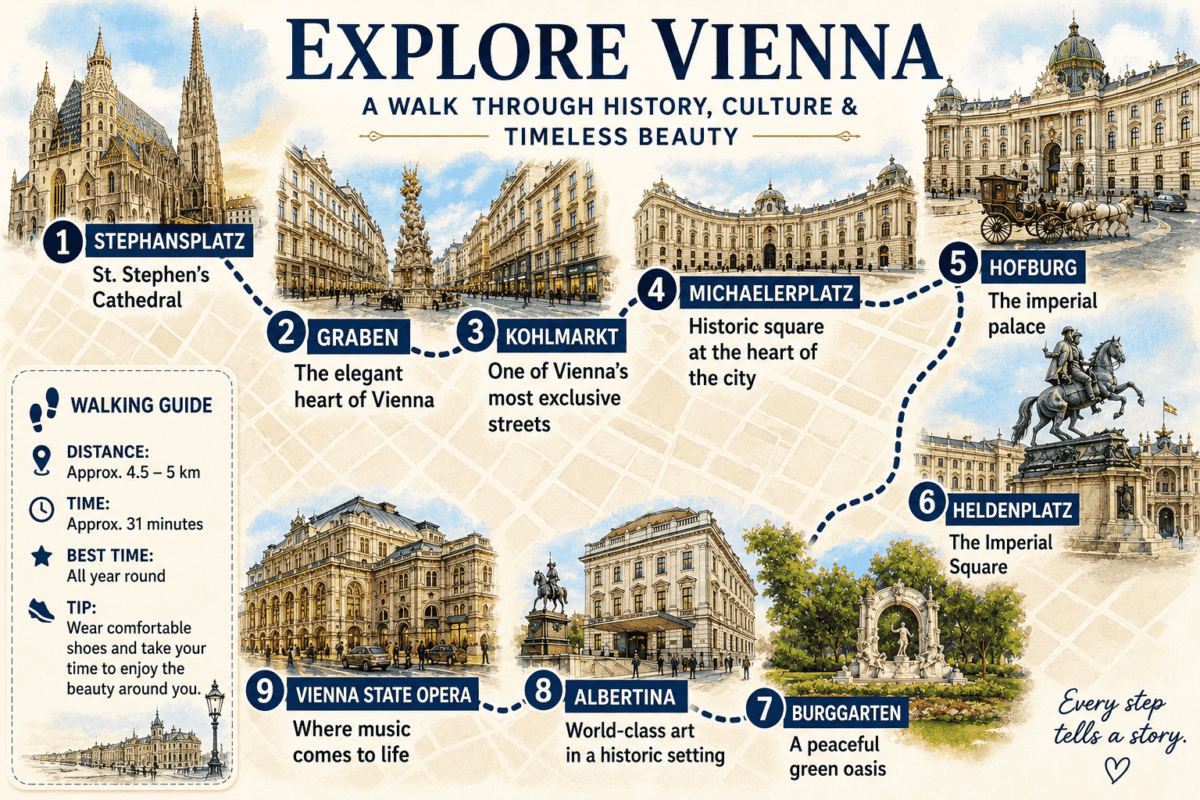
This line is not random; it can be seen that it better approximates the way from the medieval merchant city to the residence of the Habsburgs, to the Ringstrasse in the 19th century. You must understand this as a sequence & not just nine dots on a map.
Is Vienna Old Town Walkable?
Yes, Old Town is one of the most pedestrian-friendly historic centers in Europe. The area of the core spine is about 1.5 kilometers long, mainly flat, and part of which is pedestrianized. Cobblestone is the only true challenge, and in places that have cobblestones, you may need shoes with high heels and not a thin sole.
The crowd really gets thick on Graben and in the Kohlmarkt starting late in the morning, through mid-afternoon up until sunset; particularly on weekends and in summer. Stephansplatz is the most hectic. If you want photos without a wall of people in them, an early start, before 9 AM, makes a real difference.
The Natural Walking Route Through the Old Town
Here’s how the spine breaks down in practical terms, walking at a normal pace with no stops:
| From → To | Walking Time |
| Stephansplatz → Graben | 2 minutes |
| Graben → Kohlmarkt | 2 minutes |
| Kohlmarkt → Michaelerplatz | 3 minutes |
| Michaelerplatz → Heldenplatz (via Hofburg) | 8 minutes |
| Heldenplatz → Burggarten / Albertina | 5 minutes |
| Albertina → Vienna State Opera | 3 minutes |
| Opera → Stephansplatz (via Kärntner Straße) | 8 minutes |
The full loop is a walking time of around 30 minutes, making it equally suitable for a little more of a highlights walk of two hours or a slower loop that will allow for coffee with the children throughout the day. This path does not often cross over itself, leaving no sections of walk to be repeated.
Must-See Attractions Along the Route
St Stephen’s Cathedral (Stephansdom) and Stephansplatz
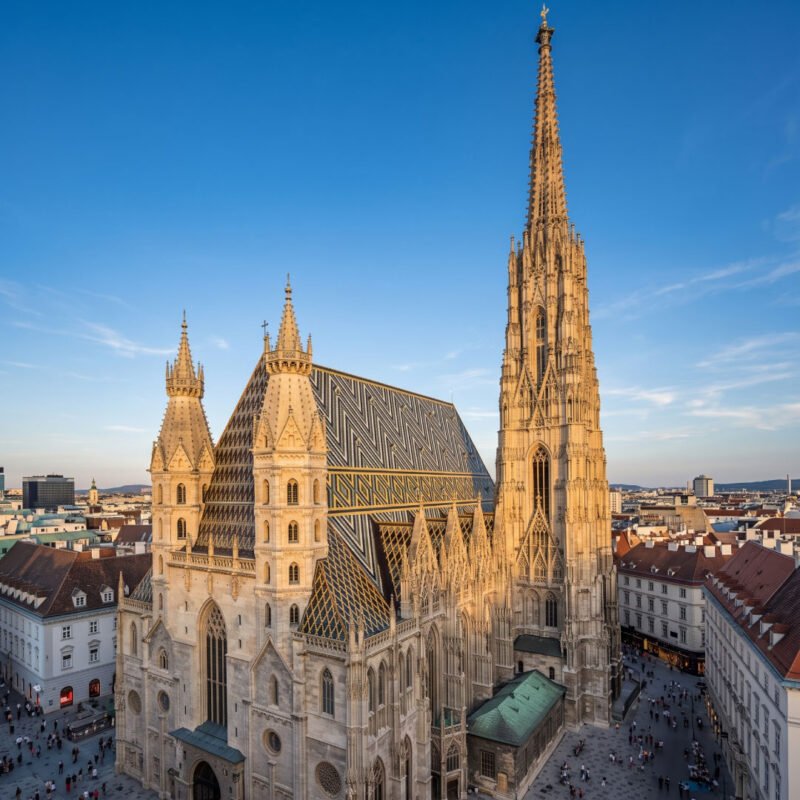
As one might expect, the obvious place, and by all means, is the literal heart of the city with its tiled roof in a diamond pattern and a Gothic nave of the 14th century. The main nave is free to enter; the South Tower climb, the North Tower elevator to the Pummerin bell, the catacombs, and the treasury are separately ticketed. Visiting hours for tourists differ from general worship hours, so check stephansdom.at before you go, particularly around Mass times.
Graben & Kohlmarkt
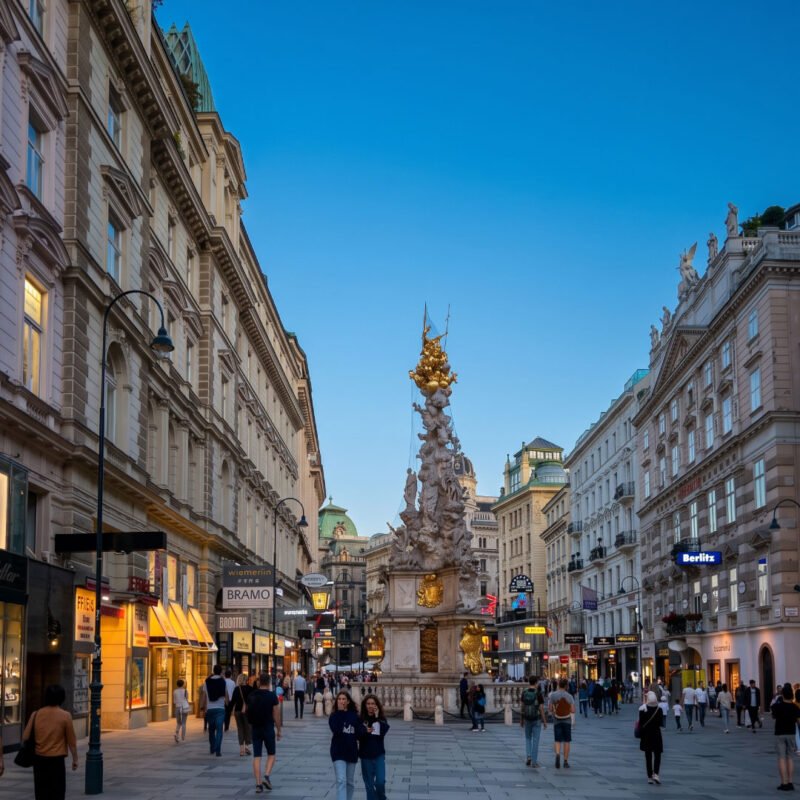
Graben is Vienna’s largest pedestrian street, with the Baroque Pestsäude Column (Pledge Column) in its midst. It runs straight on into the Kohlmarkt in a lower, more peaceful street, the home of most of the most expensive shop fronts in the old quarter, the green dome of the Hofburg framed at the far end in early light one of the good photo lines in the old quarter.
Michaelerplatz and the Hofburg entrance
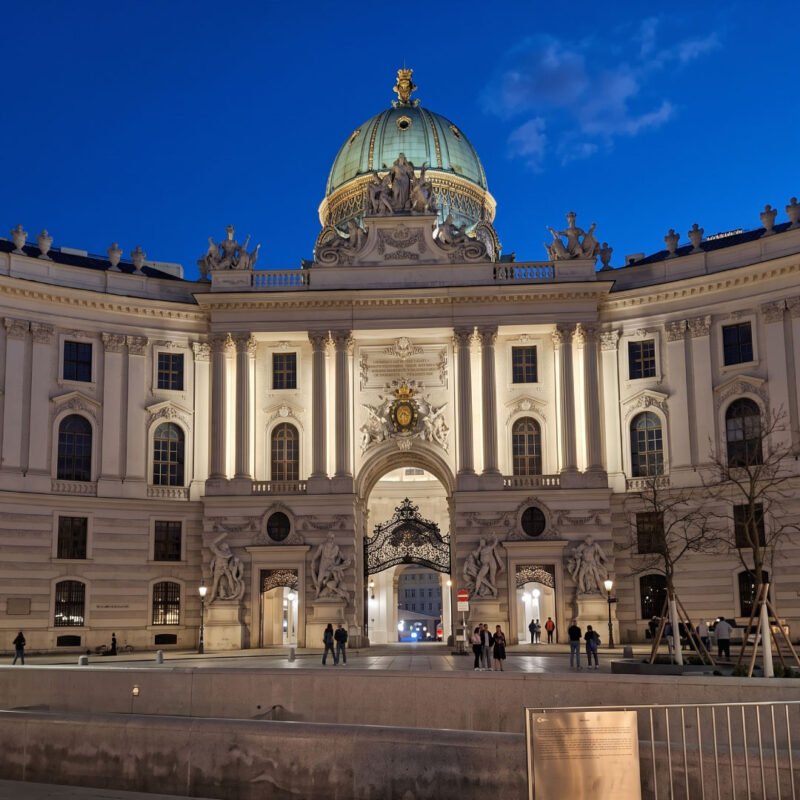
This square does double duty as living history: excavated Roman and medieval foundations sit exposed in the middle of it, right in front of Michaelerkirche and the curved facade of Hofburg’s Michaelertrakt. It’s also where Adolf Loos’s famously plain “Looshaus” faces off against the imperial dome across the square, a genuinely useful stop for architecture-minded travelers.
Inside the Hofburg
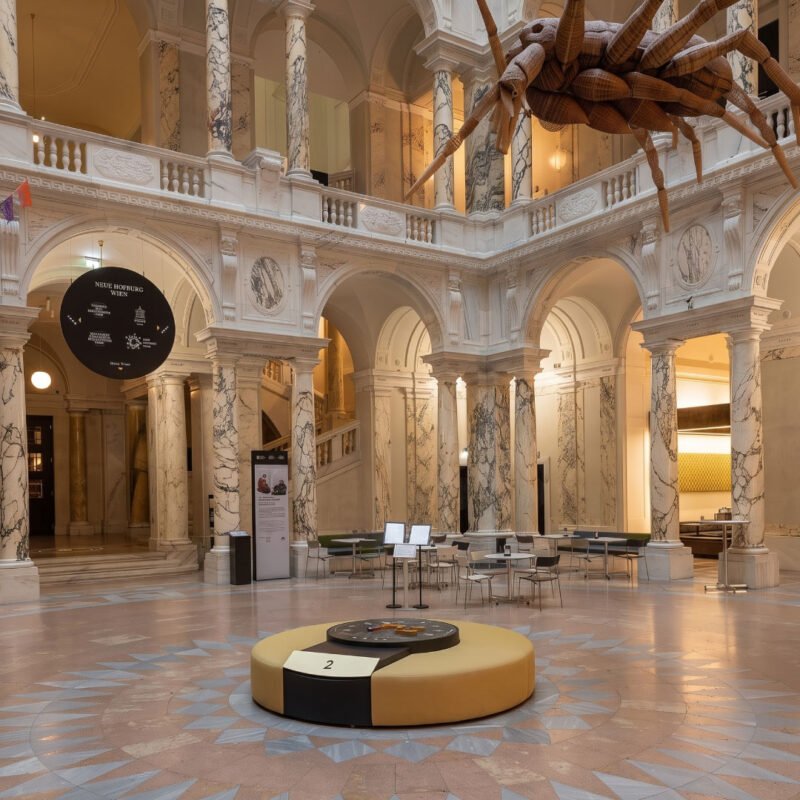
For more than 600 years, this was the habitation of the Habsburgs, and now this is a complex with several attractions. The Sisi Museum and Imperial Apartments (one ticket, audio guide included) tell the story of Empress Elisabeth and the rooms in which she spent her childhood, and of Emperor Franz Joseph and his rule. The Imperial Silver Collection, meanwhile, is temporarily closed to prepare for its renovation until November 2026.
Able to fit historic books in the surrounding corners and topped by a frescoed dome, the Austrian National Library’s State Hall is a Baroque room that is a short walk away from Stephansdom, but much less crowded. The Spanish Riding School has been hosting the Lipizzaner stallions since 1572. It offers gala shows and less costly Morning Exercise viewings throughout the year (except for summer, dates of which are subject to change, see srs.at).
Heldenplatz, Burggarten and Volksgarten
The square of Vienna’s largest size, Heldenplatz, is surrounded by the two equestrian statues and the wing of the New Hofburg, now home to various museums. On either side of it, Burggarten and Volksgarten are genuinely restful green spaces; Burggarten has the Mozart memorial and a Butterfly House; Volksgarten has rose gardens and the small Theseus Temple.
Albertina and the Vienna State Opera
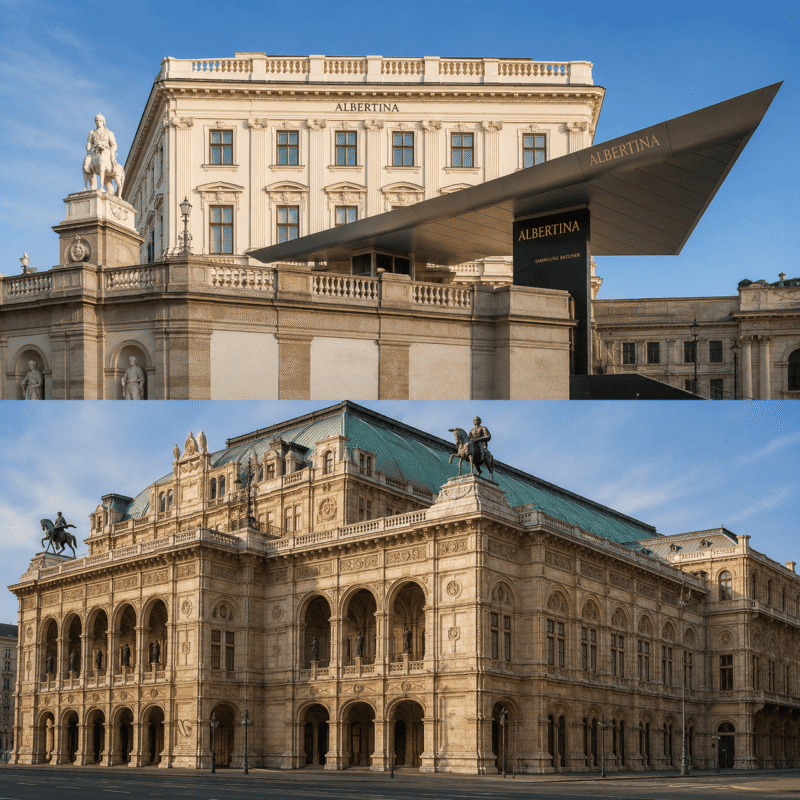
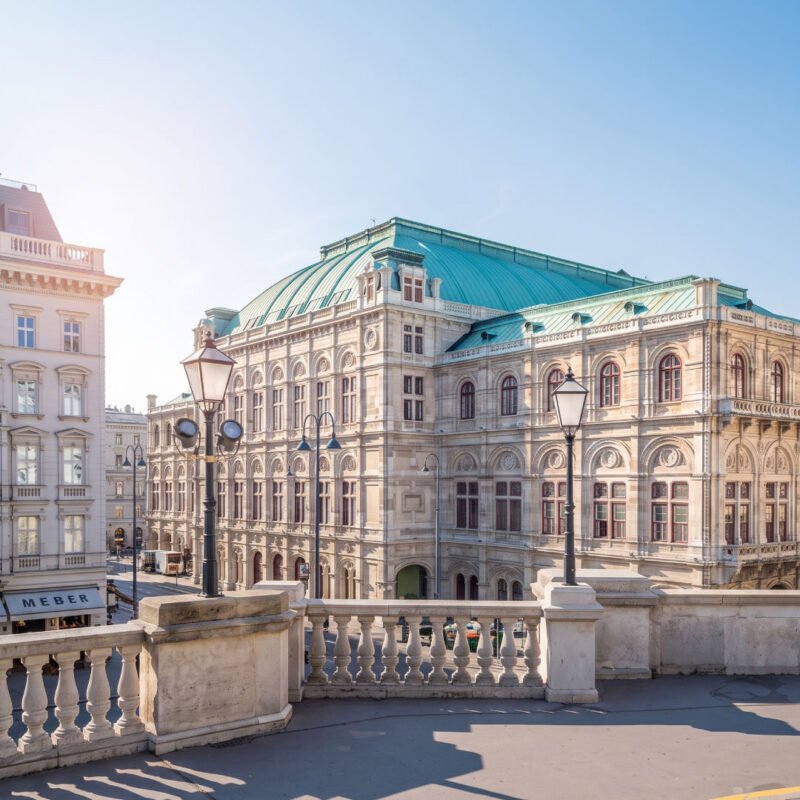
Formerly the palace of Duke Albert of Saxe-Teschen, the Albertina possesses one of the largest collections of prints and drawings in the world, and makes use of a rotating program of shows based on art from Monet to the period up to and including Picasso. It is just a few minutes to the Vienna State Opera, whose construction was completed in 1869, as one of the signature buildings of the Ringstrasse.
It is not necessary to have an opera ticket with you to appreciate this truly. Daily guided tours of the auditorium and grand staircase are available. Still, the rest of the season (September to June) is taken up by the main opera season, with the other two months (July and August) also spent by third-party (not the house) productions.
Beyond the Spine (Quieter Corners)
If you’re off the road a few streets, the number of visitors to the street goes down, and the history gets, if anything, more interesting:
- Judenplatz and Am Hof: Am Hof is the oldest square in Vienna; Judenplatz is behind it, the excavations of an Old Town synagogue are located under the Museum Judenplatz, and a Holocaust memorial is on the top.
- Freyung: An Austrian-shaped square featuring the Austria Fountain and the Schottenstift (Scots Abbey), which is occasionally still used for seasonal markets.
- Minoritenkirche: An Italian Gothic church featuring a large mosaic copy of Leonardo’s Last Supper, suggested by Napoleon, but never acquired.
- Maria am Gestade: With its proximity to the city walls, lies this seemingly bizarre Gothic church with its openwork spire, near to which the Danube was once closer.
- Peterskirche and Michaelerkirche: Both of these are hidden, ignored in favor of the cathedral. This is an oval, quirky Baroque interior building that is worth a 5-minute detour off Graben as well as daily recitals of its organ, the Peterskirche.
How Much Time Do You Actually Need?
| Time Available | Realistic Plan |
| 2 hours | Stephansplatz, Graben, Kohlmarkt, Michaelerplatz, exterior of the Hofburg. Skip any museum interiors. |
| Half day (4-5 hrs) | Full spine above + Hofburg inside (Sisi Museum or State Hall, National Library) and coffee break. |
| Full day | Spine, two interiors of the Hofburg, time in Judenplatz/Am Hof or Maria am Gestade, lunch, time in Burggarten or in the Volksgarten. |
| Two days | Day two is packed with museum visits, MuseumsQuartier, Ringstrasse, plus a gentle, second walk through the quiet squares of Old Town. |
For those who are only staying for a day, don’t attempt to visit Schönbrunn Palace and a full day in the Old Town at the same time. They’re both worth it but require half a day of their own, and rushing both leaves you, if not bored, then exhausted.
Where to Pause for Coffee, Food and Shopping
The coffee culture in Vienna is not just there to make people look pretty; it is evidence of how it functions, and one good sit-down java experience, as opposed to a takeaway cup, transforms one’s perception of the entire day. There are several cafes located within a few minutes from the main spine, namely Café Central, Demel and Café Hawelka.
The Old Town is a maze of authentic schnitzel houses in Vienna, with actually good ones, and there’s a great line to distinguish them before you sit down for some food.
The walk naturally lands at the popular shops like Kohlmarkt for refined clothing and jewelry, Graben for a combination of both, and Kärntner Straße for more conventional retailers, which will be more of a pedestrian artery connecting Stephansplatz and the Opera.
Vienna Old Town After Dark
The Old Town at night is quieter; more lit for photography; noticeably less hectic around Stephansplatz when day-trippers have finally left. The shop fronts at Graben and Kohlmarkt continue their lighting well into the dark of night, and the lighting of Stephansdom’s exterior, if anything, is more impressive when lit at night.
Also, if you can make it to the middle of Michaelerplatz without having to avert tour groups, you are in one of the few places to do that. Libra Tours Vienna has a private Vienna night tour, if you don’t want to go through the evening by yourself.
Combining the Old Town with Ringstrasse and Beyond
When you finish the historic center, you’ve found Maria-Theresien-Platz, which was formerly lined by the old City Wall, and the Ringstrasse, which was built in the 1860s with the Opera, the Parliament, the Rathaus, and the Kunsthistorisches and Natural History Museums in front of each other along the ring.
The Opera and Burggarten are right on the doorstep of none of this, but close enough to get to from there without having to breathe back through the Old Town.
If you have more than one or two days in Vienna, you’ll want to spend a half-day in the other areas further out, such as in Stadtpark, Naschmarkt, the Spittelberg neighborhood and the Neubau neighborhood.
Practical Planning Notes
Getting There
Stephansplatz (U1, U3), Herrengasse (U3) and Karlsplatz (U1, U2, U4) are the main renewal stations of the Old Town. There is the Ring tram service as well. Wiener Linien tickets are priced at: a single ticket, €3.20, a 24-hour ticket €10.20, and a 7-day ticket €28.90 (paper) or €25.20 (digital). The 48-hour and 72-hour passes no longer exist; 24-hour tickets and 7-day tickets replaced them. As the Old Town is very compact, most tourists will not need any public transport within the Old Town.
Best Area to Stay
With your base located within or very near Innere Stadt, you can enjoy everything on this map within walking distance, and the price you will pay is higher. It is better for budget-minded travelers to be closer to the U-Bahn that is not in the Ring and ride in.
Guided or Self-Guided
The Old Town is compact enough that you could explore the area with anyone or adhere to the route described in this article. A guide mainly adds context you won’t get from a map:
- Which building hides which piece of Habsburg history
- Where to stand for the best light
At Libra Tours, our Vienna private vintage carriage tours cover this same stretch, suited for those who prefer not to walk it but who still want to experience it, especially those who are older or have mobility issues.
Frequently Asked Questions (FAQs)
Q: Is Vienna Old Town the same as Vienna city center?
A: Yes. The Historic Center of Vienna is the 1st district of Vienna, which the Ringstrasse encircles, synonymous with the terms “Vienna Old Town”, Vienna “city center” and Vienna “Innere Stadt”.
Q: Can I see Vienna Old Town in one day?
A: Yes. A full day comfortably covers the entire walking spine, two or three interior visits, and time for food and coffee, though not Schönbrunn Palace on the same day.
Q: What is the most famous place in Vienna Old Town?
A: St Stephen’s Cathedral (Stephansdom), on Stephansplatz, the geographic and historical center of the city, and the natural starting point for almost any route.
Q: Is Vienna Old Town worth visiting?
A: It is indeed one of the rare historic centers in Europe still retaining a certain genuine proximity and coexistence of Roman, medieval, baroque, and imperial structures, all still in common use today and not segregated and roped off.
Q: What can I do in Vienna Old Town for free?
A: Stroll along the spine, enter Burggarten, Stephansdom and Peterskirche or Michaelerkirche, and cross Heldenplatz to sit in the Volksgarten or Burggarten. The Sisi Museum, the Albertina, and the Spanish Riding School are the main paid stops.
Q: What’s the best area to stay for Vienna Old Town?
A: Inside the Ring for maximum convenience, or near a U-Bahn stop for better value for an additional step, but not too far to walk.
Q: What should I skip if I only have a few hours?
A: With Stephansplatz, the Graben, the Kohlmarkt, the Michaelerplatz, and the Heldenplatz (turning point) as the focus points of the museums, the indoor, historical spigots are avoided, and with less than two hours, you get architecture and history.